Collapse of civil order in wartime Siberia
Doctor ZhivagoThe collapse of civil order in wartime Siberia is not a single uprising or a formal change of government but a widening failure of the protections that make ordinary life possible. The novel traces it from crowded hospitals and disrupted movement to political suspicion, competing regimes of punishment, and a final landscape in which travelers fear strangers and abandoned trains become shelters and graves. The deterioration is both institutional and intimate: public services buckle under war, while fear enters the choices people make even when they have done nothing wrong.
War Overwhelms Civilian Life
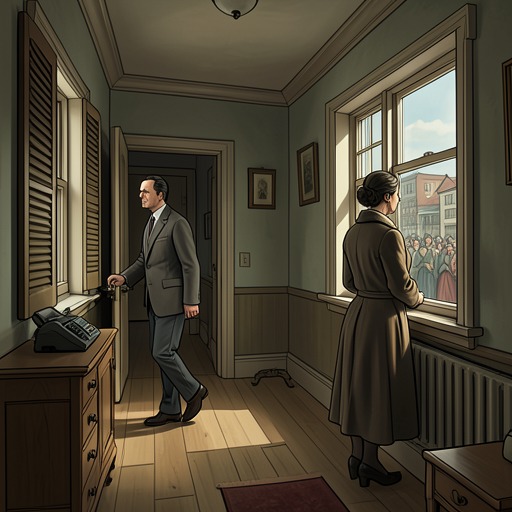
Military violence first appears as pressure on civilian institutions. At a hospital, a truck with two trailers brings wounded men to the entrance, while Moscow’s hospitals are already desperately overcrowded after the battle of Lutsk. Men are placed in passages and on landings, and the strain begins to affect the women’s wards. The arrival of casualties thus registers not only battlefield loss but the erosion of the hospital’s ability to separate care from crisis.
At a mobile first-aid station near the front, the scale of the pressure is more immediate. Ammunition carts, without springs, carry wounded men jolting along the road after they have been gathered from the battlefield during a brief lull in the artillery fire; a good half are unconscious. Exhausted survivors lie beside the road after four days of heavy fighting, too depleted to respond as the carts pass. The medical service continues to receive and treat casualties, but its work unfolds amid physical exhaustion, inadequate transport, and a flow of wounded that exceeds the capacity of ordinary care.
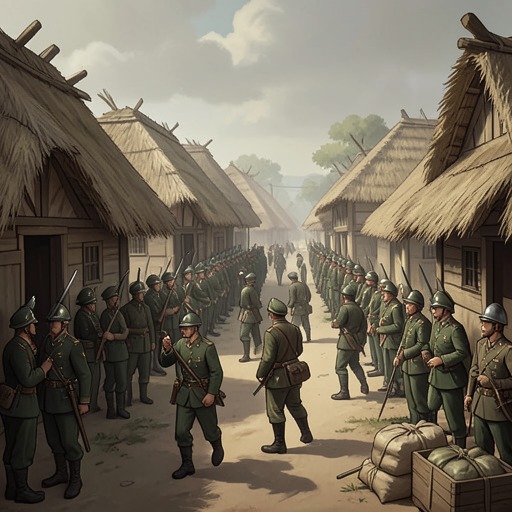
The front’s movement also makes civilian safety provisional. When the Germans break through, a village comes under fire and the hospital is moved at once, before an evacuation order arrives. Yurii Andreievich Zhivago arranges for Misha Gordon to leave in the first party, and they run through the village under fire toward the waiting carriage. The retreat is improvised around immediate danger: official procedure has not caught up with events, and departure depends on hurried decisions made in the streets.
Displacement, Conscription, and Political Fear
The breakdown of order is also visible in how people are moved and classified. A train carrying civilians has twenty-three cars, with the Zhivago family in the fourteenth; sailors occupy the front, civilians the middle, and labor conscripts eight cars at the rear. There are about five hundred conscripts, drawn from sharply different circumstances and occupations. Lawyers and stockbrokers sit by hot stoves, trading stories and laughing because they expect influential relatives to intervene or believe they can buy their way out. Their confidence contrasts with the involuntary gathering of people under a common administrative label, despite their varied lives and unequal means of escape.
Political suspicion reaches beyond formal political activity. After a village party, several young men flee when they hear that the militia has arrived and hide under the floor of a barn. Some have run simply because they are drunk and frightened; a few worry that their company with local hooligans could be taken as evidence against them. In the divided political order, hooliganism can be read as black reaction in the Soviet zone or as Bolshevism in the White zone. The young men’s fear rests not on a clear offense but on the possibility that almost any association may acquire a political meaning. Their cramped hiding place gathers people from two villages, turning an impulsive escape into a small tableau of a society where people conceal themselves before they know what they are accused of.
Retaliation and the Rival Authorities
The competing armed powers do not restore security. A wounded deserter reaches the partisan camp after punitive forces have made him crawl from the camp’s outposts; he reports that investigators have tortured and terrorized people and that the authorities are closing in. His warning identifies the perpetrators as men serving Hetman Bekeshin, Colonel Strese, and General Vitsyn. He dies before he can finish speaking. The episode presents terror not as an abstract rumor but as testimony delivered to the people it is meant to frighten, and its immediate consequence is news of a larger danger spreading through the camp.
The doctor’s recollections place this report within a cycle of reprisals. He remembers the autumn, the shooting of rebels, and Pamphil Palykh’s killing of his wife and children; White and Red atrocities answer one another, with outrage producing further outrage. The partisan camp’s own exposure to punishment and violence does not make it an escape from the wider conflict. Instead, the remembered killings connect the threat outside the camp to the suffering already carried within it, while the doctor finds the accumulated horror difficult to explain to Liberius.
The Railway and the Return to Yuriatin
By the time Yurii Andreievich makes his way back to Yuriatin on foot, the collapse has spread across the transport network and the countryside. He follows a railway line that is out of use, neglected, and covered with snow. Trains abandoned after the defeat of Kolchak stand immobilized for miles: some have become strongholds or hiding places for armed bands, criminals, and political fugitives; others have turned into mortuaries and mass graves for people overcome by cold or typhus. The railway, once a means of movement, now records the failure of movement and the abandonment of those who depended on it.
The danger extends onto the road. Travelers turn aside at the sight of one another, and strangers kill because each fears being killed first. The narrative also notes isolated cases of cannibalism and describes a world in which the ordinary laws of civilization have been suspended. These are not presented as a new, stable social order but as the fearful consequences of a vacuum in which trust and protection have become scarce.
Among the figures encountered in this landscape is Terentii Galuzin, whom the partisan camp believed had been shot. He survived, recovered in the forest, and now makes his way home under an assumed name, hiding in buried trains and fleeing from people he sees. His passage links the violence of the partisan camp to the wider population of the displaced and presumed dead. When Yurii finally reaches Merchant Street in Yuriatin, exhausted and with little more than bread and suet, the town appears to him like a friend. That relief sharpens the measure of the journey: a familiar inhabited place has become a rare prospect of safety.
Narrative Significance
The episodes form a progression across different scales rather than a single, uninterrupted account of institutional collapse. Hospital overcrowding shows the strain on care; the threatened village and divided train show how warfare reorganizes movement; the barn and the partisan testimony reveal suspicion and political terror; and the snowbound railway makes abandonment a physical condition of the landscape. Each setting records a different failure, but together they show how military conflict reaches beyond the battlefield into work, transport, shelter, and relations between strangers.
The novel also resists assigning the violence to only one political side. The doctor recalls White and Red atrocities as mutually escalating, while the wounded deserter’s account gives specific form to the danger posed by Vitsyn’s forces. That juxtaposition keeps the account attentive to particular perpetrators without treating any faction’s claims to order as proof that ordinary people are protected. The result is a portrait of civil order collapsing through repeated local crises: authority remains visible in armies, militia, and commands, yet its presence does not reliably produce safety, justice, or mutual trust.